Ladies of Data Recap: Perspectives on AI and society
Posted on
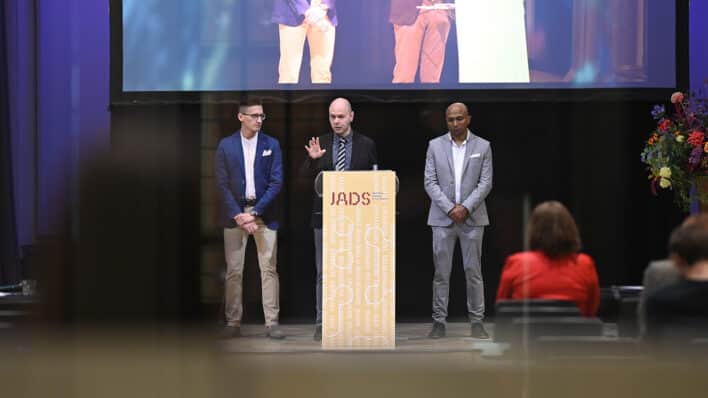
At JADS Chapel, a founder, a lawyer, a curator, and researchers took the mic. Women gathered once more, not for the household-and-industry school once run by sisters, but for Ladies of Data 2025.
AI can make businesses grow faster, yet it can also mirror old stereotypes. It can fuel innovation and still blur legal lines. Here’s what stood out.
Introduction — Ksenia Podoynitsyna

Ksenia opened with GenAI’s “now,” not “someday.” By late spring 2025, big names like Microsoft, Meta, and Google were already reshuffling teams across ICT, marketing, sales, and HR—indirect evidence of how quickly the ground is moving, especially for junior roles. Her advice was simple and practical: pick your models thoughtfully, remember that many are trained to “bluff” with confident answers, and check your settings; paying for a license doesn’t automatically stop your data from being used. Above all, keep the focus on real value for users.
“It’s not a crystal ball anymore; it’s happening.”
Keynote 1 — Adriana Pereira

Adriana’s story was entrepreneurship in fast-forward. Fashion has lagged in tech, so The Fabricant first leaned into 3D tools and then pivoted fully to AI. The change was dramatic: from about 50 people and weeks to build a single 3D dress, to a five-person team delivering photoreal results in minutes. Her message: low barriers, low cost, and high speed now favor small, mission-driven teams. Be lean, automate earlier, stay flexible, hire for AI fluency, and keep your purpose steady even as your methods evolve.
“You need taste and taste is not something that AI has. AI produces a lot. But who is deciding this is good enough?”
Breakout — Flor Miriam Plaza del Arco
 Flor started with a question from the audience: Would you share your feelings with a chatbot? Interestingly, 48% of attendees said yes. But Flor’s research shows large language models can pick up society’s stereotypes: women are more often tagged as sad, and men as angry. These patterns matter when tools are used for support. The takeaway wasn’t to fear the tech, but to use it with care: be transparent that it’s non-human, keep people in the loop, and watch for bias so we don’t reinforce what we’re trying to move beyond.
Breakout — Naomi Moonen

Naomi zoomed out to the global picture. Investment in GenAI has surged since late 2022; the U.S. leads, Europe and Asia are catching up, and new ventures are popping up in healthcare, education, and e-commerce. The tension is familiar: regulation protects rights and trust but can slow the pace. The goal is “responsible speed”: move fast, but not carelessly.
Breakout — Anne-Karlijn van Kesteren

Drawing from the exhibition Women as Technology, Anne-Karlijn showed how tech quietly teaches us about gender. Early computing relied on women, yet their contributions were sidelined. Today, many service technologies still default to female voices and bodies, and “AI girlfriend” apps market compliance as a feature. Her nudge to the room: widen who builds and how we build, so our tools challenge old patterns instead of replaying them.
Keynote 2 — Colette Cuijpers
 GenAI raises so many interesting legal questions that for a lawyer it feels like being a kid in a candystore. Big lawsuits are pending regarding intellectual property rights, privacy and data protection, unfair business practices, and consumer protection, just to name a few. The EU employs a risk-based approach, focused on being precautionary and preventing negative outcomes by designing numerous rules and regulations that developers and users must adhere to (prevention is better than cure). The U.S. employs a harm-based approach: they allow development (leaving it more to the market) but impose severe fines and cures if harm is caused. For anyone building across borders, that means knowing both playbooks. Colette mentioned a few reminders:
- Data ownership is a myth: from a legal perspective, you can’t even own data, but you can have rights to data.
- When you are making use of data, you need to think about whether or not someone else might also have a right to the data.
- Copyright remains human-centric; animals (or machines) can’t have a copyright (yet).
- “Public” doesn’t always mean “free to scrape.”
Ksenia’s final encouragement to early-career women in data: bring what AI can’t: taste, judgment, and domain insight. If more women help write the defaults, the future these systems learn from will look a lot more like all of us. Stay close to real use cases, keep deepening your craft, build your network, and become AI-literate. Continue to educate yourself throughout; it doesn’t finish when you do the bachelor or the master’s, you need to continue developing yourself.
This recap was made by our partner Datory, your premier source for understanding and leveraging AI and Data Science.