Turning GenAI into a meaningful business strategy
Posted on
While employees everywhere are busy experimenting with AI chatbots and text generators, many leaders are wrestling with a deeper question: what does this technology really mean for my strategy? That challenge brought nearly a hundred professionals from organizations like FIOD, ASML, Gemeente ’s-Hertogenbosch, Gemeente Eindhoven and many more to JADS for an afternoon of insight, exchange, and collaboration.
The event, part of the Engineering Doctorate (EngD) program in Data Science, focused on one question: how can companies make GenAI a strategic driver rather than a side experiment?
From concept to impact
After a warm welcome from hosts Anne van Breda and Sandra van den Poll, academic director Aarnout Brombacher opened the session by introducing the JADS EngD program. He described how the two-year, post-master trajectory connects academic depth with real business challenges. Each EngD candidate works hands-on with partner companies to develop AI and data solutions that deliver measurable impact, creating direct value for both industry partners and future innovation leaders.
His message set the tone for the afternoon: GenAI isn’t an isolated innovation it’s part of a larger movement linking knowledge, people, and practice.
The business perspective: AI that acts
Saskia Dekkers, Lead AI Specialist at CM.com, offered a vivid look at how companies are using Agentic AI.Systems that don’t just generate responses but act. She showed how CM.com’s AI agents handle customer requests, personalize interactions, and update orders automatically.

Dekkers argued that while AI tools have matured fast, business adoption often lags behind. Only about 5% of AI pilots reach production, a statistic she attributed to unclear strategies, shallow use cases, and weak data foundations. “Many companies focus on visibility over value,” she said. “The best AI cases aren’t always the most visible.They’re the ones that remove friction.”
Her maturity model helped attendees reflect on where their own organizations stand: from early experimentation to fully integrated, strategic use of AI.
The academic perspective: lessons from the lab
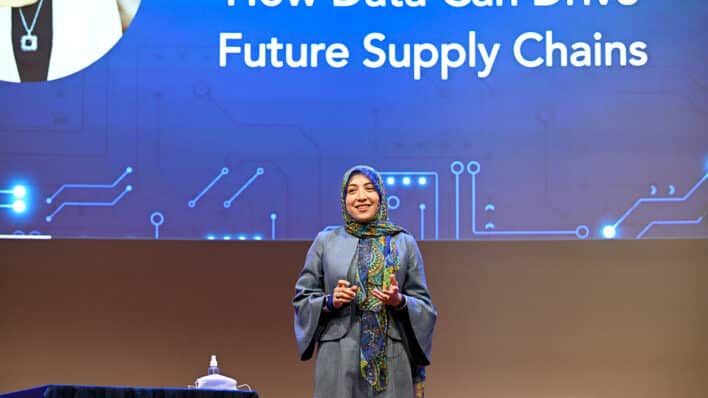
When one of the original keynote speakers fell ill, Dr. Indika Priyantha Kumara Weerasingha Dewage, assistant professor in Data Governance at JADS, stepped in. His presentation drew on several master projects, showing how JADS research translates directly into business practice.
From multi-agent systems at ASML that rewrite and validate complex technical procedures, to AI agents for business process discovery and sentiment analysis in startups, Indika illustrated how research on Agentic AI moves from concept to implementation.

One case stood out: a multi-agent system developed by JADS students corrected nearly half of a company’s outdated machine procedures:—saving time, ensuring compliance, and catching the attention of Microsoft’s CEO during his AI tour of the Netherlands.
As one visitor shared online:
“🚀 Agentic AI on the rise. Just attended an inspiring seminar explaining how multiple AI agents can work together. Based on research done at JADS. Thanks Indika Kumara for your insights.”
Breakout sessions: translating insight into action
After the keynotes, participants joined interactive roundtables led by Saskia Dekkers, Dr. Indika Kumara, Aarnout Brombacher, and Cristoffer Leite. These discussions zoomed in on practical barriers, cultural shifts, and data challenges that organizations face when integrating GenAI.
As one attendee reflected afterward:
“It was a great combination of business experience and academic insight. One highlight was the interactive roundtable session, where we exchanged ideas on questions like:
- ‘The biggest barrier to AI success isn’t the technology, but the integration with existing data and processes.’
- ‘Outsourcing AI initiatives holds back innovation and long-term strategic growth.’”
Key outcomes from the breakout sessions
Exploration over execution
Most companies are still figuring out what AI really means for them. Interest and urgency are high, but so is hesitation. The main barriers aren’t technical—they’re about people, processes, and governance.
ROI pressure limits innovation
The pressure to prove ROI before starting holds innovation back. If outcomes must be certain upfront, there’s little room to explore or fail fast. This mindset widens the gap between what technology can do and what organizations actually need.

Surface-level adoption and privacy concerns
Deep AI integration is rare. Many companies stay at the surface or outsource, risking data control and missing the chance to build internal expertise. Privacy worries also persist—few know where their data goes or how it’s used, which limits adoption.
From caution to action
Despite the challenges, the mood was optimistic. Practical AI can start small—by automating repetitive, low-value tasks. As major software providers embed AI into their tools, adoption will only accelerate. The takeaway: success won’t come from technology alone, but from organizations willing to experiment, learn, and trust AI as part of everyday work.
Continuing the conversation
The event closed with informal drinks in the JADS chapel, where discussions continued about risk, data ownership, and the balance between experimentation and ROI. Many visitors stayed to connect with JADS researchers and EngD candidates about potential collaborations.
For JADS, the day underlined the importance of bringing research and business together, not as separate worlds, but as partners shaping the next generation of data-driven strategy.

What’s next
JADS invites all participants, and anyone exploring how to build an effective GenAI strategy, to share their data and AI challenges with the JADS team. The EngD program specializes in translating those challenges into research-backed, practical solutions that deliver business value.